
Features: Calendar | Lunar Almanac | Monthly Topic
This Month's Night Sky - NOTE: The next paragraph describes the sky as it appears at 10 pm EST (11 pm EDT) near mid- month. The sky also looks this way at 11 pm EST (midnight EDT) during the beginning of the month and at 9 pm EST (10 pm EDT) by month's end.
Starry Trails:
Suzieastro
Classical Astronomy
The Sky this Month
Sky Maps.Com
Monthly Download
Tonight's Sky
Youtube Video from
hubblesite.org
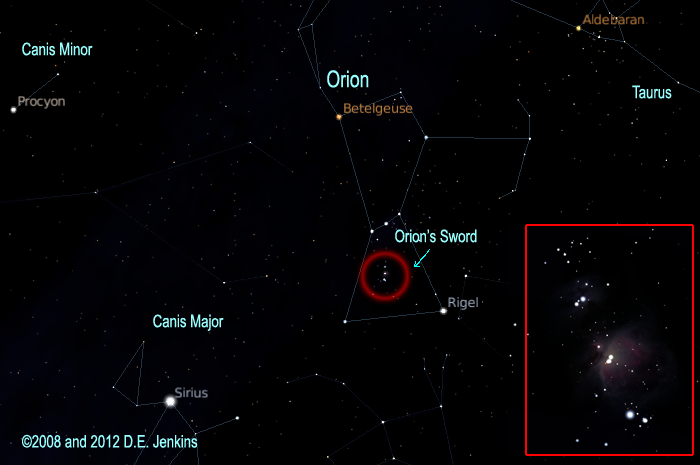
Some believe the winter night sky is the most beautiful of the year! By mid-month, misty Pleiades, the famous open star cluster of the constellation Taurus, is visible due S. at 10 pm. Although part of the constellation Taurus, it lies above its "lazy V" (>) asterism whose brightest star, orange-tinted Aldeberan, glows near the point of the lower branch of the "V". Above are the constellations Perseus, Cassiopeia (whose "W" shaped asterism is unmistakable) and Auriga. Lovely Orion, whose asterism reminds me of a slightly lopsided hour glass, moves upwards from the SE. Note its three "belt" stars located at the "pinch" of the hour glass. The hazy object below the middle belt star is M42, the Great Orion Nebula, a region of space where stars are being born. Orion is followed by the bright stars Procyon (Canis Minor) and Sirius (Canis Major). Along with the bright star Betelgeuse (Orion), these three stars form the famous "Winter Triangle". To the E shine the Gemini twins, Castor and Pollux. In the SW, the diamond-shaped Great Square of Pegasus stands on one corner while high in the N, Ursa Major's asterism, the Big Dipper, stands on its "bowl".
MERCURY early in the month is visible in the morning sky near, is best placed for 2012 during the first 2 weeks of the month, especially for observers in the northern hemisphere, reaches greatest elongation. VENUS is bright in the morning sky, will be positioned near Mercury. The inner planets will put on a great show this month, but you'll need a very good E horizon and beware of the Sun. JUPITER is is at opposition on the night of December 3, the best time to observer the solar system's largest planets. MARS sets in the early evening, soon to disappear in the Sun's glare. SATURN appears earlier every morning, moving into Libra. Outer planets NEPTUNE and URANUS are well placed for telescopic observations this month.
Calendar of Events
NOTE: For those observers not in the ET zone, convert the calendar times to your zone's time by subtracting one hour for CT, two for MT and three for PT. Don't forget to adjust for Daylight Savings Time when necessary by subtracting one hour from your planisphere's time; dawn and dusk times must also be corrected. See your local newspaper, TV news, or cable TV's Weather Channel for sunrise and sunset times. Unfortunately some of these events may occur during daylight hours in your area.
| DATE | EVENT |
01 |
Mercury at greatest heliocentric latitude N. |
03 |
Jupiter at opposition. |
04 |
Mercury at greatest W elongation. (21 deg) |
07 |
Jupiter 5 deg N of Aldebaran. | 09 |
Asteroid Vesta at opposition. |
9-11 |
Venus 1.6 deg N of the Moon. Again this month, Venus dances with the waning crescent moon, enjoy the show with Spica, Saturn, Venus, and a special player this month, fleet footed Mercury. |
09 |
Spica .8 deg N of the Moon, occultation from the Indian Ocean and Antarctica. |
10 |
Saturn 4 deg N of the Moon |
12 |
Mercury 1.1 deg N of the Moon, occultation from South America and southern Africa. |
14 |
The Geminid meteor shower peaks before dawn. This shower has been reported at 120 per hour. The new moon makes this year an excellent opportunity to see what this shower can do. This shower peaks around midnight. |
18 |
Spica .8 deg N of the Moon, occultation from the Indian Ocean and Antarctica. |
19 |
Ceres makes its closest approach to Earth. At magnitude 6.7, it will be between the stars at the tip of the horns of Taurus.(Elnath and Zeta Tau) The asteroid Vesta is also in Taurus this month. |
21 |
Winter Solstice, the Sun at its most extreme southern declination. |
22 |
The Ursid meteor shower has a rate of 10 meteors per hour. |
25 |
Moon at Apogee. |
26 |
Jupiter .4 deg N of the Moon. Occultation from southern South America and southern Africa. |
29 |
Mars hits its southern heliocentric extreme. |

Lunar Almanac for December 2012
| Phases of the Moon | Phase and Date(s) | Best viewed before local midnight |
 |
New |
Deep Space Objects |
 |
1st. Qtr |
Planets & Moon |
 |
Full |
Moon |
 |
Last |
Deep Space & Planets |
Topic of the month: Orion, pt. 2
|
The Winter sky boasts of one of the most popular constellations, Orion. Indeed, the three belt stars were mentioned in the Bible as being bound together and, indeed they are. Together they were born and together they will die.
One of the brightest and most beautiful diffuse nebula in the sky, the Great Nebula in Orion (M42) is visible with the naked eye. Astrophotos will show off its beautiful colors, but the human eye sees a faint green glow, if any color is detected at all. A fabulous mixture of bright stars and reflection nebula, the Great Nebula is not soon forgotten. In the heart of M42 is the Trapezium, a multiple star system roughly shaped like its namesake. They has ben identified as Theta Orionis. These stars were created out of the dust and gas that is highly concentrated in this area of the sky. The stars themselves have blasted away the interstellar dust, so that they appear to reside in a dark hollow at the heart of the nebula. The young stars are also variable and it can be interesting to telescopic observers to see how many they can identify on any given night. Usually, the four brightest stars, designated by alphabet letter, A, B, C, and D, can be easily found. The C component is the bright star, a little brighter than sixth magnitude and at the threshhold of naked eye brightness. Components a and B are known to be eclipsing binaries. Two identified members of this multiple star are designated as E and F and may be seen by keen observers with telescopes. M43 is a portion of the Great Nebula that is a bit detached from the main body and has it's own designation. (For an image of the Great Nebula in Orion, go to Astronomy Picture of the Day.) M78 (NGC 2068) is north of the great Orion Nebula and has been mistaken for a comet by telescopic observers. It consists of two B-type stars that are enclosed in a wispy nebula. Also nearby is the object NGC 1999, another star cluster surrounded by nebulosity. Another famous object near the great Orion Nebula is called the Horsehead Nebula (IC 434). Located near the belt star, Zeta Orionis, although to some people, the dark and light nebular patches say it looks to them like a full sized horse, seen from behind with his head turned back toward the observer. There are two other faint nebulae in the constellation, Barnard's Loop and the Flame Nebula (NGC 2024), but these are beyond the typical back yard observers. Barnard's Loop is huge, about 300 light years across. It is well seen on long exposures of the Orion constellation and some observers report being able to see it in the night sky. It may be the remenant of a supernova explosion that took place 2 million years ago. These nebulae are also members of the Orion Molecular Cloud Complex, that is part of the Milky Way's Orion Arm. This is one of the most intense regions of stellar formation recognized in the Milky Way, approximately 1,500 light-years distant from Earth. --See You Under the Stars! The star chart above, including the Great Nebula of Orion, was generated by Stellarium, a free open source planetarium program. The above image was created by Dawn Jenkins, using Stellarium and a graphic editing program to format the image for this web page. Editing was done for educational purposes only. Stellarium offers much more to amateur astronomers and is being used in planetariums and to guide telescopes in the field. Simple charts like the one above can be used on the internet for non-profit, illustration purposes. Proper credit is due of course! Thank you to the makers of this fine program from Astra's Star Gate. |
This installment of "Whats Up?" is ©2012 by Dawn Jenkins for Astra's Stargate. View Ron Leeseburg's Farewell Issue
What's Up Home | The Observer's Page
Links to other Stargate Pages:
[ Astronomy ] [ Space ] [ StarWimin ] [ Starfleet ] [ MayaAstro ] [ Observers ]