
Features: Calendar | Lunar Almanac | Monthly Topic
This Month's Night Sky - NOTE: The next paragraph describes the sky as it
appears at 10 pm EST (11 pm EDT) near mid- month. The sky also looks
this way at 11 pm EST (midnight EDT) during the beginning of the month and
at 9 pm EST (10 pm EDT) by month's end.
This Month's Night Sky - Arcturus (Bootes) shines high
overhead as night falls. Spica (Virgo) glows in the SW
while Regulus (Leo) vanishes over the W horizon before
midnight. The "big dipper" (Ursa Major's asterism)now
stands on its "handle" in the N. Antares (Scorpius)
is low on the S horizon. The E sky is dominated by the
"summer triangle" asterism: Deneb (Cygnus), Vega (Lyra)
and Altair (Aquila). An interesting star tour begins at
the last star of the big dipper's handle, Alkaid.
Following the curve of the handle, "arc to Arcturus".
Now, following the same curve, "spike to Spica" and
"continue to Corvus", its distinctive four star,
kite-shaped, asterism.
At the beginning of the month, VENUS is first to appear
as evening twilight deepens. Then MERCURY follows low in
the W. Now, in the WSW, yellowish SATURN becomes visible
high above Venus and Mercury. As the night sky darkens,
JUPITER shines brightly all alone in the ESE. Look SE to
see reddish MARS and W to see Jupiter in the early morning
sky. The summer SOLSTICE occurs on the 21st. This is the
time that the SUN is at its highest point in the sky and
summer begins in our hemisphere.
Calendar of Events
NOTE: For those observers not in the ET zone, convert the calendar times to your zone's time by subtracting one hour for CT, two for MT and three for PT. Don't forget to adjust for Daylight Savings Time when necessary by subtracting one hour from your planisphere's time.; Dawn and dusk times must also be corrected. See your local newspaper, TV news, or cable TV's Weather Channel for sunrise and sunset times. Unfortunately some of these events may occur during daylight hours in your area.
| DATE | EVENT |
01 |
Look for a conjunction (less than a degree) of Venus and Saturn at 9pm. |
02 |
Look W about an hour after sunset to see the
planets Mercury (below, right), Venus (middle,
center) and Saturn (above, left) lined up in an
almost perfect diagonal. |
16 |
Look for a conjunction (6 degrees) of the Moon and Mercury 5am. |
17 |
Look for a very close (less than a degree) "conjunction" of the bright star Regulus (Leo) and the Moon at 5am. |
19 |
Look for a very close conjunction (less than half
a degree) of the Moon and Saturn at 4am.
Look for a "conjunction" of the Moon and the bright star Regulus (Leo) at 8pm. There may be an occultation (the Moon "covering" Regulus) around 9:30pm, depending on your location. |
21 |
The summer solstice occurs at 2pm. Welcome to summer! Unfortunately, now each day will to grow a tiny bit shorter until the winter solstice when each day will begin to grow a bit longer again. At 9 pm, look for a very close "conjunction" (less than half a degree) of the Moon and the bright, reddish star, Antares (Scorpius). Don't be fooled! Because of its color, Antares is often mistaken for the planet Mars. |
28 |
Look for a "conjunction" of the Moon and the bright star Antares (Scorpius). Remember that "Ant Ares" translates to "Not Mars" but is often mistaken for that planet due to the red giant's glow. |
30 |
Tonight's Full Moon is called the Summer Moon. Look for a very close conjunction of Venus and Saturn. |

| Phases of the Moon | Phase and Date(s) | Best viewed before local midnight |
 |
New |
Deep Space Objects |
 |
1st. Qtr |
Planets & Moon |
 |
Full |
Moon |
 |
Last |
Deep Space & Planets |
Topic of the month: Lunar feature: Lunar craters, Hercules and Atlas
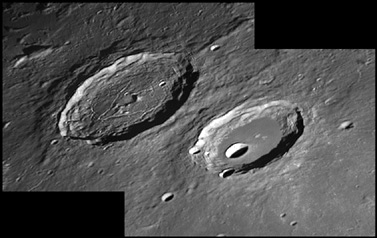
| This month (and, I expect, for the rest of the year) we'll
use the image of the full Moon to help locate our lunar
objects. By convention, North is generally up. This is
how the full Moon appears when viewed by the naked eye and
in binoculars. Remember that astronomical telescopes often
inverts the image of the Moon. Sometimes east is also
reversed with west in telescopes.
The pair of craters, Hercules (about 43 miles in diameter)
and Atlas (some 56 miles in diameter) are located in the
Moon's NE quadrant just below the "sea" called Frigoris.
Although their rims and walls appear similar, their
interiors are quite different.
--See you next month ! |
| The above image was taken from Damian Peach's web site, " The Moon in Close Up" from Damian Peach's Views of the Solar System at www.damianpeach.com. This image is reproduced by permission. | |
This installment of "Whats Up?" is ©2007 Ronald A. Leeseberg, encoded by Dawn Jenkins for Astra's Stargate.
What's Up Home | The Observer's Page
Links to other Stargate Pages:
[ Astronomy ] [ Space ] [ StarWimin ] [ Starfleet ] [ MayaAstro ] [ Observers ]


