
On this page: Intro > Starship HLS > Uncrewed Demo > Starship vs. SLS > Awarding the Contract >
Artemis Human Landing System (HLS)

NASA plans to return humans to the moon by 2028 under the Artemis program. Humans are destined to reach for the Moon, our nearest solar system destination. An important part of reaching the Moon, is landing. That original Apollo 11 mission was the first lunar landing in history. Under Artemis, NASA will build a lunar colony. This requires a more robust system, capable of carrying more cargo. It also will allow astronauts to remain on the surface for days, rather than hours.
In September 2019, NASA announced a contract for USA industry to propose designs for a human lunar landing. On April 30, 2020, NASA selected three companies to begin development on the Artemis Human Landing System - - Blue Origin, Dynetics, and SpaceX. In October 2021, SpaceX won the contract with its Starship lunar lander under development. In March 2022, NASA announced a new contract, HLS Sustaining Lunar Development, in order to have multiple vehicles to carry crew to land and lift off from the lunar surface. In May 2023, NASA awarded Blue Origin the contract. Details on the contracts can be found on this page.
+ Check out NASA's About Human Landing Systems Development
Navigate Astra's Artemis Website
Artemis Pages: Artemis Home | Space Launch System | Artemis HLS | Lunar Exploration
Artemis Mission Pages: Artemis I |Artemis II | Artemis III |Artemis IV
⋆ ⋆ ⋆
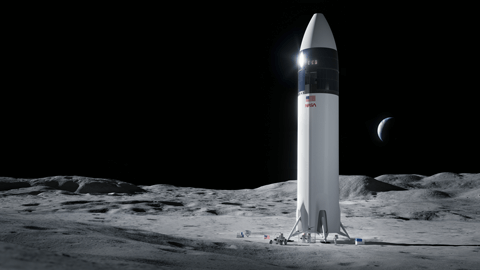
In April 2020, SpaceX was awarded a $135 million contract under NASA Artemis program's Human Landing System to develop a lunar-optimized variant of its Starship spacecraft. The SpaceX proposal included in-space propellant transfer demonstrations, a technology SpaceX will have to develop for future Starship missions to the Moon or Mars. SpaceX also must complete an uncrewed lunar test landing.
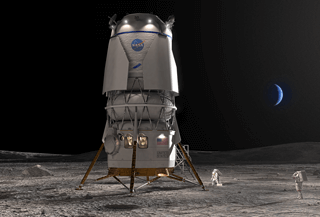
In May 2023, NASA awarded Blue Origin the HLS Sustaining Lunar Development contract. Blue Origin’s team includes Lockheed Martin, Boeing, Draper, Astrobotic, and Honeybee Robotics.
In February 2026, NASA announced a change to their Artemis architecture. A mission was added between the second and third missions, making Artemis-III an orbital mission instead of a lunar lander. For this mission, Blue Origin and SpaceX will demonstrate their human landing systems in low-earth orbit.
⋆ ⋆ ⋆
Starship Human Landing System
SpaceX Starship
SpaceX is working on a modified version of the Starship currently developing and testing at Boca Chica, TX. The Starship lander includes a large cabin and two airlocks for astronauts to perform moon walks.
NASA has exercised an option under the original HLS contract, requiring SpaceX to make an uncrewed Lunar Starship that will be launched before the crewed mission, Artemis-3. The uncrewed Starship HLS will be optimized to operate on and around the Moon. Because it does not need to re-enter Earth's atmosphere it does not have a heat shield. The spacecraft will land on the Moon but is not required to launch from the Moon's surface. This means the SpaceX hardware will remain on the lunar surface. It is possible that the uncrewed ship could then become part of a lunar base in the future.
+ + Find out more about SpaceX HLS at The Moon page at SpaceX.
Starship HLS Design
Starship HLS uses ~24 midbody oxygen-methane thrusters to land on the lunar surface. It will be capable of remaining 100 days in lunar orbit. Its mass will be ~100 tons when landing on the surface. It will have a 100 ton lunar upmass although the NASA requirement meant for the lander to be less than 1 ton. Starship HLS will be able to support a greater number of extravehicular activities (EVAs) or moonwalks on the lunar surface than the minimum required by NASA. There will be fuel left over after landing that can be used if it becomes necessary to do an emergency ascent from the Moon. Starship HLS includes an elevator required to go from the crew cabin to the surface because it is a very tall lander. The elevator design is fault-tolerant and designed to operate in lunar conditions.
Most of the above information comes from Wikipedia and detailed technical information is very hard to find. This page will be updated with more details as they come out. If you want to learn more you could try going to NASA's site and find out how little they've really put out as I did - - Astra
NASA used Option B of their contract with SpaceX, to fund changes to Starship HLS lander system to support the new requirements (working with the Lunar gateway) and a second crewed demonstration mission.
Starship Uncrewed Lunar Lander Demo
In 2022, NASA announced that it wanted a second lander and required SpaceX to launch a demo landing mission to be launched before committing the lives of four astronauts on a dangerous space mission. The Starship HLS used for the technology demonstration will not need to launch from the surface, so it can remain on the lunar surface for future use. Under the terms of the contract, this spent vessel will belong to SpaceX.
+ + Find out more about SpaceX Starship at Astra's SpaceX page.
⋆ ⋆ ⋆
HLS Sustaining Lunar Development
In March 2022, NASA released a draft solicitation to award a second Human Landing System (HLS) contract. The new contract, called HLS Sustaining Lunar Development, was created to ensure that lunar explorers would have multiple vehicles to land and lift off from the lunar surface. The contract requires an uncrewed and crewed demo mission for the new human landing system. The new lander design must be able to carry more mass and dock with the Gateway Lunar Station.
SpaceX was specifically not included in the new solicitation, because NASA exercised an option for SpaceX to transform its proposed human landing system into a spacecraft that meets the requirements for recurring services and mandates a second demonstration mission.
In May 2023, NASA selected Blue Origin and the National Team to design, develop, test, and verify its human moon lander to meet NASA’s human landing system requirements. The Blue Moon lander will support recurring astronaut expeditions to the lunar surface, including docking with Gateway, the space station in lunar orbit where the crew transfers to the landing system. The contract includes an uncrewed demonstration mission to the lunar surface before a crewed demo on the Artemis V mission in 2029. The contract that was awarded is fixed-price at $3.4 billion.
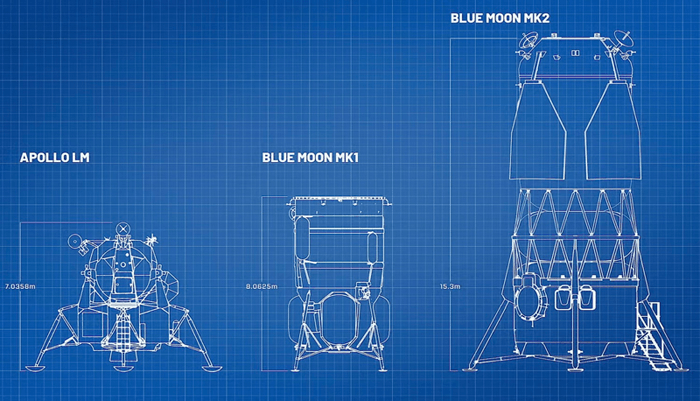
Blue Origin posted this drawing comparing the Apollo Lunar Landing Module (LMM) to the Blue Moon MK-1 lander, and the Blue Moon MK-2 human landing system. Besides the obvious height differences, the Blue Moon landers can carry a lot more cargo to the lunar surface than the LMM could.
⋆ ⋆ ⋆
Comparison of Three Human Landing Systems
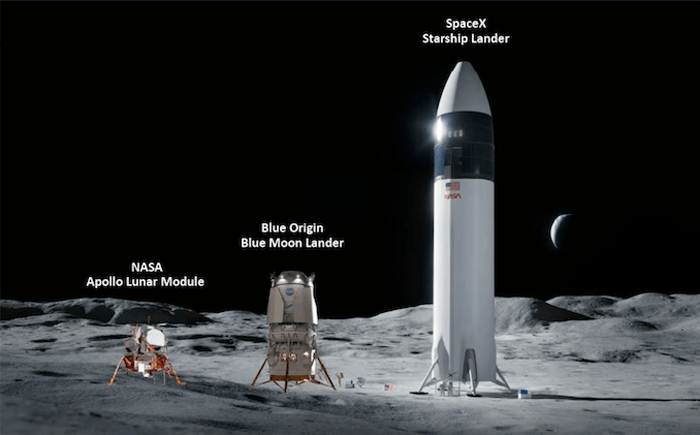
It is interesting to compare the various human landing systems from NASA. It is important to remember that the new lunar landers are much larger than the Apollo lander. They carry more fuel and will sustain astronauts for days, rather than the hours the first astronauts had to explore our closest neighbor. The image below was published by the NASA Office of Inspector General, on March 10, 2026, NASA’s Management of the Human Landing System Contracts. The publication is available at the given link.
+ + Find out more about Blue Origin human landing system at Astra's Blue Origin page.
⋆ ⋆ ⋆
The Competition for Artemis Human Landing Systems
In September 2019, NASA announced a contract for USA industry to propose designs for a human lunar landing. On April 30, 2020, NASA selected three companies to begin development on the Artemis Human Landing System - - Blue Origin, Dynetics, and SpaceX.
In April 2020, along with 2 other proposers, SpaceX was awarded a $135 million contract under NASA Artemis program's Human Landing System to develop a lunar-optimized variant of its Starship spacecraft. NASA plans to return humans to the moon by 2024 under the Artemis program and this award provided the funding to develop a prototype. The SpaceX proposal included in-space propellant transfer demonstrations, a technology SpaceX will have to develop for future Starship missions to the Moon or Mars. SpaceX also must complete an uncrewed lunar test landing.
Integrated Lander Vehicle (ILV)
Blue Origin is the prime contractor for the National Team that includes Lockheed Martin, Northrop Grumman, and Draper Laboratory. Their Integrated Lander is a three-stage vehicle that builds upon the expertise with spaceflight of each member of the team. The National Team's Human Landing System can be launched individually on commercial rockets or combined to launch on NASA’s SLS rocket.
Blue Origin is the prime contractor for the Integrated Lander Vehicle. Blue Origins is building the Descent Element that is based on the Blue Moon lunar lander and their BE-7 engine. Lockheed Martin is developing the Ascent Element vehicle and leads crewed flight operations and training that is based on their Orion experience. Northrop Grumman works on the Transfer Element vehicle that takes the vehicle from lunar orbits to the surface and is based on their Cygnus vessel. Draper has the lead for descent guidance and provides flight avionics.
ALPACA Lunar Lander
Dynetics' Autonomous Logistics Platform for All-Moon Cargo Access (ALPACA) is a single spacecraft that can provide descent and ascent capabilities. It uses modular propellant tanks that fuel the engines at different stages of the mission. The crew cabin is low to the surface, making it easy for astronauts to enter, exit, or transport tools and samples. ALPACA can dock with Orion and also with the Gateway for refueling. The entire vehicle will return from the lunar surface for the crew to transfer back to Orion. The lander will be launched on a United Launch Alliance Vulcan Centaur rocket.
SpaceX Starship HLS
SpaceX's Starship HLS is an optimized version of the rocket system that is under development. It will launch into low-earth orbit and be refueled by a separate Starship tanker. Several refuel launches will be necessary. Starship HLS will deliver astronauts to the lunar surface. The design includes an elevator to carry astronauts to the surface from the Starship crew compartment. The rocket will stand over 165 feet or 50 meters tall. It will carry a crew of up to four astronauts, and a large amount of cargo.
Awarding the Contract
In the end, SpaceX was awarded a firm-fixed price, milestone-based contract total award value of $2.89 billion on April 16, 2021. Subsequently protests were filed by Blue Origin and Dynetics and the award fee wasn't immediately received by SpaceX. It is not unusual for such protests to be filed, especially for large contracts. The Government Accountability Office (GAO) reviewed the protest claims and found that NASA did not violate procurement law on July 30, 2021. The GAO ruled in SpaceX's favor. NASA did not have the budget to choose two systems, they had to until 2022 to put out a solicitation asking for bids on a second Human Landing System.
#AstrasStargate #ImaRocketFan
 Return to Astra's Stargate