
Blue Origin, LLC
Blue Origin was founded in 2000 by Jeff Bezos, and is headquartered in Kent, Washington. Their goal is to make access to space cheaper and more reliable through reusable launch vehicles. Blue Origin is an aerospace developer that built the suborbital New Shepard rocket and the heavy-lift New Glenn rocket. Blue produces engines for its own rockets and for other vehicles, notably United Launch Alliance's Vulcan Centaur. Working on NASA's Artemis program, as a commercial lunar payload provider, Blue Origin is developing the MK1 lunar lander. They also have a contract to build a human lander, "Blue Moon" based on the MK technology. Other projects include the Blue Ring spacecraft platform and the Orbital Reef space station.
Blue Origin’s New Glenn rocket explosion!!
On May 28, 2026, Blue Origin’s New Glenn rocket exploded during a static fire test at Launch Complex 36 at Cape Canaveral Space Force Station, Florida. The explosion caused damage to Launch Complex 36, Blue Origin’s only operational New Glenn launch site. It has been called one of the largest rocket explosions in U.S. history.
Disaster Updates
Jun 30, 2026 | Blue Origin update with progress on the disaster clean-up: New Glenn Return to Flight
⋆ ⋆ ⋆
Blue Moon Human Landing System
Blue Moon Mark 2 (MK-2)
The Blue Moon MK-2 is Blue Origin's crew-rated lunar lander that will carry two astronauts to the lunar surface. After the lunar surface operations, MK-2 will return them to the Orion Crew Module in lunar orbit where they will rejoin the two other crew members. The actual MK-2 crew lander stands about 52 feet tall. The crew cabin is located at the base of the lander. This is the living and working area where two astronauts will eat, sleep, conduct science, and observe the lunar environment during their stay. Astronauts can stay on the lunar surface for up to 30 days in the Blue Moon lander.
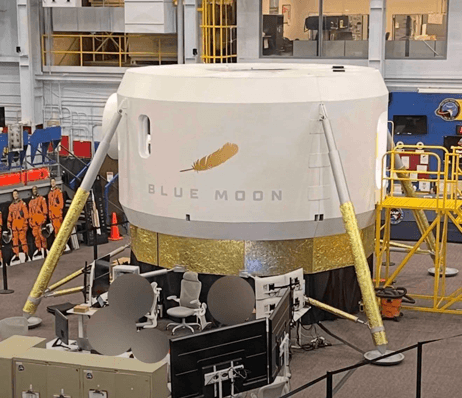
A mockup of the Blue Moon Mark 2 (MK-2) lunar lander has been assembled in the Space Vehicle Mockup Facility (SVMF) at NASA's Johnson Space Center. Astronauts will be able to train for lunar missions using the Blue Moon mockup. The full-size mockup includes the exterior ladder where astronauts will climb into the vehicle from the surface of the Moon.
⋆ ⋆ ⋆
Blue Origin Commercial Lunar Payload Systems (CLPS)
Blue Moon Mark 1 (MK1)
Blue Moon MK-1 lander is a cargo transporter that is launched on Blue Origin's New Glenn launch vehicle. It can deliver up to three metric tons anywhere on the lunar surface. For its pathfinder mission, MK1 is called, "Endurance" and is very nearly through testing by NASA. Endurance was designated Moon Base I by NASA in May 2026.
Instruments for MK-1 Pathfinder Mission:
Stereo Cameras for Lunar Plume Surface Studies (SCALPSS) will capture video and still images from the area under the lander when the engine plume disturbs the lunar surface.
The Laser Retro-Reflector Array (LRA) is a reflector that bounces light that shines on it backward, 180 degrees from the light source. The LRA has eight retroreflectors that are attached to the lander deck. After being installed on the Moon's surface, LRA is designed to bounce laser light from orbiting and landing spacecraft to enable precision laser ranging. Too small for laser ranging from Earth, the LRA will serve as a location marker on the Moon for decades.
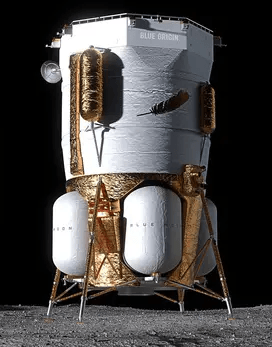
NASA has awarded Blue Origins task orders for three additional MK-1 landers. The second MK1 lander will deliver NASA's VIPER rover to the Moon's South Pole.
- - Read more about Blue Origin Lunar Landers on Astra's Artemis HLS page.
⋆ ⋆ ⋆
The National Team
Blue Origin leads the National Team consisting of aerospace contractors including Lockheed Martin, Draper, Boeing, Astrobotic, and Honeybee Robotics. The National Team failed to be selected by NASA under the Artemis Human Landers program, but was awarded a contract on May 19, 2023 under NASA's NextSTEP-2 Appendix P Sustaining Lunar Development (SLD). The National Team will develop a lunar lander that can make a precision landing anywhere on the Moon’s surface for the Artemis-5 mission. The contract also includes the development of a cislunar transporter. These vehicles are to be powered by liquid hydrogen (LH2) and liquid oxygen (LOX) also known as LOX-LH2.
⋆ ⋆ ⋆
Blue Origin Engines
Blue Origin has developed a number of engines and variations. This page will not cover the various engines in depth. The primary engines discussed here the BE-4 and the BE-7 engines.
Blue Engine 4 (BE-4)
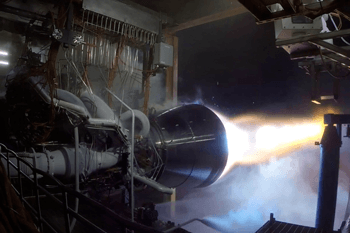
The Blue Engine-4 (BE-4) uses liquefied methane fuel and uses an oxygen-rich staged combustion cycle. The BE-4 produces 2,800 kN (640,000 lbf) of thrust at sea level. Seven BE-4 engines power New Glenn rocket first stage, and two BE-4 engines power the first stage of the Vulcan rocket owned by United Launch Alliance launch vehicle.
Blue Engine 7 (BE-7)
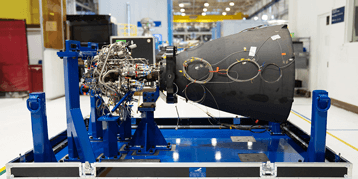
The Blue Engine 7 uses a liquid hydrogen/oxygen dual expander cycle engine. It is intended to be used with the Blue Moon lunar landers. It can generate 10,000 lbf (44,000 N) of thrust, during lunar ascent and descent engines on the Blue Moon landers. Blue Origin posted this image of the BE-7 engine on X (Twitter) during testing at Edwards Air Force Base, California in 2024.
⋆ ⋆ ⋆
Orbital Spaceflight - New Glenn
The New Glenn rocket is named after John Glenn the first American astronaut to reach orbit. The New Glenn is a heavy-lift launch vehicle. It is planned that the New Glenn will be capable of carrying people and payloads to Earth orbit and beyond. The goal is to reuse the first stage of the New Glenn rocket 25 times. The rocket will be 70 feet (21.9 meters) high with a fairing diameter of 23 feet (7 meters). It uses seven BE-4 engines on its first stage and two BE-3U engines on the second stage. Blue Origin will recover the booster on a floating offshore platform. Full re-usability is the company's goal.
The maiden flight of Blue Origin's New Glenn rocket was launched on January 16, 2025. The rocket launched successfully, with the first stage (GS-1) placing the second stage (GS-2) and a prototype of its own satellite platform (Blue Ring) into Medium Earth Orbit. Unfortunately, the GS-1 booster was lost and could not be retrieved on the Blue Origin ocean platform, Jacklyn.
NASA launched the Escape and Plasma Acceleration and Dynamics Explorers (ESCAPADE) mission on New Glenn's maiden flight on November 13, 2025. ESCAPADE mission consists of two small probes that will study Mars’ magnetosphere. The New Glenn rocket placed the twin spacecraft into low earth orbit. The spacecraft moved into an orbit looping around the Sun-Earth Lagrange point 2 (L2). They will use the Earth's gravity to slingshot to Mars in the fall of 2026.
- - Find out more about Mars ESCAPADE mission on Astra's Mars Exploration page
On April 19, 2026, New Glenn's third flight was launched with a reused first stage. The mission ended with a failure of the second stage. Unfortunately, the payload was too low to operate and it was deorbited. The first stage returned successfully to the Jacklyn ocean platform. A mishap was declared by the Federal Aviation Administration that grounded New Glenn pending a mishap investigation. On May 22, the FAA cleared New Glenn to return to flight. Unfortunately, the mishap on May 28, 2026 has left the New Glenn rocket grounded again. Updates to Blue Origins progress can be found in the box at the top of this page.
#AstrasStargate #ImaRocketFan
⋆ ⋆ ⋆
Sub-orbital spaceflight - the New Shepard
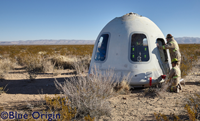
The New Shepard rocket is named after Alan Shepard, the first American astronaut to go to space. New Shepard is a reusable suborbital rocket system that can take astronauts and research payloads past the Kármán line considered the boundary between space and Earth.) The final goal is to take humans to space as a commercial venture as well as for professional astronauts. The spacecraft allows an 11-minute flight powered by the New Shepard rocket to provide passengers a view from space. As of July, 2021, the New Shepard has been launched 24 times. On July 20, the New Shepard carried its first human payload.
The image here shows Blue Origin workers recovering the New Shepard-10 after landing on January 23, 2019. Note the large windows for astronauts and passengers that will provide full view for 8 minutes during the flight of the New Shepard. Image credit Blue Origin.
The New Sheppard system includes a booster and a crew capsule. The booster is powered by a Blue Origin 3 engine (BE-3) that returns to Earth and is reusable. It is the first suborbital booster to make a vertical landing. The crew capsule returns to Earth separately, deploying parachutes and making a relatively soft landing on the surface.
In September 2022, an uncrewed mission of the New Shepard had an anomaly due to a failure of the BE-3PM main engine. The launch escape system triggered and the capsule landed safely. The remaining New Shepard launch vehicles were grounded while the FAA investigated the incident. Blue Origin found the cause of the anomaly to be failure of an engine nozzle that triggered the capsule's emergency escape system to activate. The system did its job as expected, although it would have been a harrowing ride for anyone on the vessel. New Shepard flights resumed on December 19, 2023 with the NS-24 flight. The return to flight included 33 payloads and 38,000 postcards as the Postcards to Space program.
Blue Origin announced on January 30, 2026, that New Shepard launches would be suspended for at least two years while the company focuses on developing lunar landers for the Artemis mission.
- - Find out more about Blue Origin's New Shepard launch on Astra's Space Tourism page.
#AstrasStargate #ImaRocketFan
New Shepard Launches All Female Crew
Blue Origin is launching an all-female crew on its New Shepard rocket. The mission is designated, NS-31 and is planned for launch on April 14, 2025. The six crew members are Katy Perry, Gayle King, Lauren Sánchez, Aisha Bowe, Amanda Nguyen, and Kerianne Flynn. Just a side note: Lauren Sánchez is Jeff Bezo's wife.
A good article on this mission written by Brett Tingley was published at Space.com on March 28: Katy Perry, Gayle King blast off on star-studded all-female Blue Origin rocket launch on April 14
⋆ ⋆ ⋆

On July 1, 2021, Blue Origin announced that Wally Funk, an 82-year old experienced pilot and retired FAA investigator, will have a seat on the launch of the New Shepard rocket on July 20 as an honored guest. The successful flight also included Jeff Bezos, his brother Mark Bezos, and 18-year-old Oliver Daemen.
Read the Blue Origin press release
Read starwoman Wally Funk's biography on Astra's Women in Space page
⋆ ⋆ ⋆
Blue Origin has been working on many other projects, including Blue Ring, a spacecraft that will provide in-space logistics and delivery for commercial and government customers and Blue Alchemist, a NASA Tipping Point partnership ($35 million) to produce solar cells from lunar regolith. The process being developed for Blue Alchemist will produce oxygen as a by product that has applications for life support and propulsion.
Blue Origin is a partner with Sierra Space Corporation on the Orbital Reef spacestation.
⋆ ⋆ ⋆
Club for the Future
Blue Origin's Club for the Future was founded in 2019. Its purpose is to inspire students to pursue careers in STEM with emphasis on space development and exploration. One program is Postcards to Space where students create a postcard, send it to Blue Origin and it is launched on the New Shepard. As of April 2021, over 25,000 have been received and sent into space on the New Shepard. Blue Origin also collaborates with other organizations that promote space education. The club also has a facebook page.
- - Find out more on the Blue Origin web page.
 Return to Astra's Stargate home