
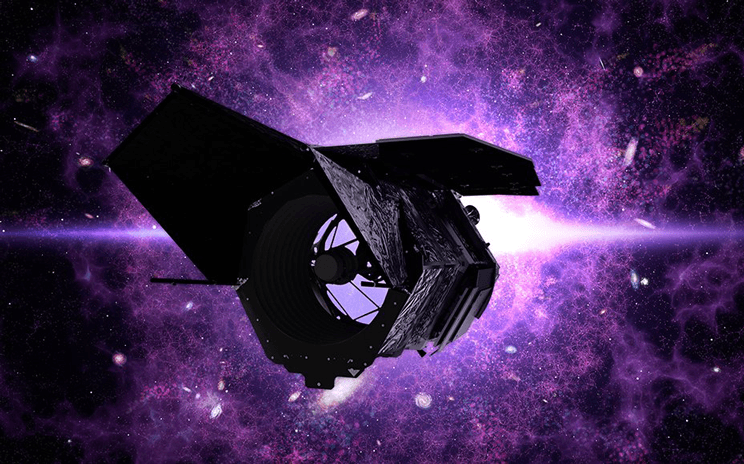
Roman Space Telescope
The Nancy Grace Roman Telescope has a 7.9 ft or 2.4 m primary mirror. It has a 300-megapixel, wide-field camera for imaging and spectroscopy and an advanced coronagraph for hunting exoplanets. Its five-year mission will be conducted while the spacecraft is orbitting the L-2 sun-Earth position.
While under development, the telescope was called the Wide Field InfraRed Survey Telescope (WFIRST). It was renamed in 2020 in honor of Nancy Grace Roman, NASA’s first Chief of Astronomy. Roman has been called the "mother" of NASA’s Hubble Space Telescope due to her tireless "mission" encouraging NASA and the astronomical community to create an important optical telescope.
⋆ ⋆ ⋆
Roman Telescope Optical Assembly
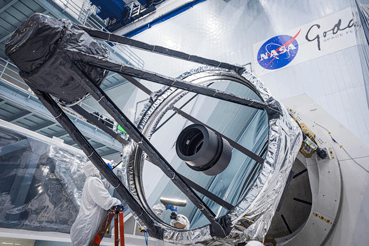
Credit: NASA/Chris Gunn
Even though the Roman telescope and the Hubble telescope have the same size mirror of 2.4 meters, the Roman telescope has a much wider field of view due to advanced optics and software. While Hubble can only take images of ~2.5 arc-sec, or about half the size of a full moon, the Roman telescope makes images at least 100 times larger than Hubble's.
The Roman telescope is a survey instrument; that means it covers large areas of the sky. Data from the Roman telescope will be available as soon as it is processed. The Hubble Space Telescope works in the near ultraviolet, visible, and near-infrared while Roman focuses mainly in the infrared. Its sensitivity starts at .5 microns and ends at 2.3 microns. Roman complements James Webb that works from 2.4 to 5 microns in the infrared. Both Roman and Webb telescopes orbit the Sun near the Sun–Earth L2 Lagrange point, about 1 million miles or 1.5 million km from Earth, in a halo orbit. That is, when the Roman telescope reaches its final orbit.
The Nancy Grace Roman Space Telescope was launched by a Falcon Heavy on August 30, 2026. It will establish a Sun–Earth L2 orbit about 100 days after launch.
⋆ ⋆ ⋆
Roman Telescope Instruments
Wide Field Instrument (WFI)
The Wide Field Instrument (WFI) is Roman’s primary science instrument and enables large scale surveys. The WFI is a 300-megapixel visible-to-NIR imaging camera and slitless spectrometer.
Coronagraph Instrument (CGI)
Cold Sensing Module (CSM)
Warm Electronics Module (WEM)
Coronagraph Instrument (CGI)
NASA, "The Roman Coronagraph is a system of masks, prisms, detectors and even self-flexing mirrors built to block out the glare from distant stars and directly image the planets in orbit around them."
- - Find out more about Roman instruments WFI Reference Information - and Coronagraph - from Science at NASA
⋆ ⋆ ⋆
Nancy Grace Roman
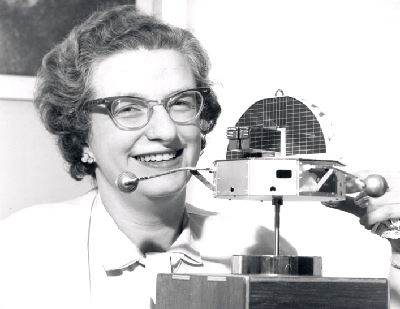
Known sometimes as the "Mother of Hubble" , Nancy Grace Roman was hired by NASA in 1959 to help set up the Office of Space Science. In 1960, she was made the Chief of Astronomy, the first woman to hold an executive position at NASA. Nancy was instrumental in developing the agency’s many space telescopes.
The picture here shows Nancy with a model of the Orbiting Solar Observatory (OSO). Nancy was in charge of the OSO program. It consisted of 8 satellites, the first one successfully launched in February 1962 and was designated OSO-2.
Other astronomical satellites that Nancy Roman oversaw reads like a list of who's who of orbital astronomical observatories. Among these include the Small Astronomy Satellite series: SAS-1,the X-ray explorer Uhuru; SAS-2, a gamma ray observatory that discovered Geminga an interesting gamma source; SAS-3, an X-ray telescope named Copernicus. She was involved with Infrared Astronomy Satellite (IRAS), Cosmic Background Explorer (COBE), and International Ultraviolet Explorer (IUE). She was also involved with astronomical experiments on Spacelab, Gemini, Apollo, and Skylab. Nancy also led NASA’s airborne astronomy program, putting telescopes on airplanes. This enabled NASA to fly a 12-inch telescope on a Learjet and a 36-inch telescope for the Kuiper Airborne Observatory. She even helped to put astronomical experiments on balloons.
Read Nancy Grace Roman's biography on Astra's Biographies of Extraordinary Women page
⋆ ⋆ ⋆
Resources
Nancy Grace Roman Space Telescope - NASA Science Mission page of the Roman Space Telescope
Nancy Grace Roman Space Telescope - NASA's Roman mission blog
Find more images at NASA's Nancy Grace Roman Space Telescope Flickr page.
Nancy Grace Roman Telescope - by Atomic Laboratory on Instagram. A nice Roman telescope infographic.
Hubble, Roman and Webb Space Telescopes Infographic - from NASA Scientific Visualization Studio
NASA Scientific Visualization Studio compares three current space telescopes: The Hubble, The James Webb and the Nancy Roman telescopes. The infographics can be downloaded for use in other presentations.
As NASA explains: Hubble views the cosmos in infrared, visible and ultraviolet light, providing a more comprehensive, high-resolution view of individual objects. The Roman Space Telescope will expand on Hubble’s infrared observations specifically, using a much larger field of view to create enormous panoramas of the universe with the same high resolution. Webb will also conduct high-resolution infrared observations, peering across farther stretches of space with a narrower field of view.
This webpage is ©2026 D. E. Jenkins all rights reserved. Please use the contact page to get permission to use this content or to send comments or corrections.
Last Modified 09/11/2026
Links to other Stargate Pages:
- Astronomy |
- Space |
- StarWimin |
- NE Asteroids |
- Ancient Astronomy |
- Observers |
- What's Up? |
 Return to Astra's Stargate home