
Features: Calendar | Lunar Almanac | Monthly Topic
This Month's Night Sky - NOTE: The next paragraph describes the sky as it
appears at 10 pm EST (11 pm EDT) near mid- month. The sky also looks
this way at 11 pm EST (midnight EDT) during the beginning of the month and
at 9 pm EST (10 pm EDT) by month's end.
Angular Measurement Review: It is interesting to note that the relationship between the angle subtended by combinations of fingers on your fully outstretched arm are the same for all viewers. This is due to the fact that the hand's size is proportional to the arm's length. A shorter arm is attached to a smaller hand while a longer arm is attached to a larger hand, thus the angle measured remains the same. If you hold your arm fully outstretched, your little finger, when sighted down your arm, is one degree wide. Your three middle fingers is five degrees, your fist, 10 degrees, and the distance between your little finger and your pointer finger is 15 degrees no matter what your age or size.
Arcturus (Bootes) shines high overhead and Spica (Virgo) still glows in the SW. Now Regulus (Leo) drops below the W horizon before midnight. The "Big Dipper" asterism (Ursa Major) stands on it's handle in the N and Antares (Scorpius) lies low in the S. The dim constellations Ophiuchus and Serpens are located above Antares. In the E sky, note the stars of the "Summer Triangle" asterism: Altair (Aquila) below, Denab (Cygnus) above with Vega (Lyra) in between but to the right. If you follow the curve of the "Dipper's" handle you will pass through Arcturus then through Spica and finally arrive at the kite-like asterism of Constellation Corvus, "flying" on its side.
MERCURY rises in the E about an hour before dawn and will be visible until about the 10th. Although it glows brightly, June's dawn is also very bright, making it hard to see unless you use binoculars. BE CAREFUL OF THE RISING SUN! VENUS rises in the W and appears highest in the sky just after sunset. It sets in the NW around 10 PM. MARS becomes visible in the SW after sunset. It sets in the W early in the night and is too far away to show surface features in all but the largest amateur telescopes. JUPITER rises in the E just after midnight but will remain fairly low in the night sky. It will become invisible in the SE as the Sun rises. SATURN is visible in the SW as the Sun sets and will set around midnight in the W. Although its ring system is beginning to open again they are still very "thin" making the planet rather dim. However, its a good time to observe its largest Moons, Titan and Rhea, if you have access to a telescope. The Bootid meteor shower peaks early in the morning of the 24th. and Summer begins on the 21st. this year. Although there is a partial eclipse of the Moon on the morning of the 26th., it won't be visible here.
Calendar of Events
NOTE: For those observers not in the ET zone, convert the calendar times to your zone's time by subtracting one hour for CT, two for MT and three for PT. Don't forget to adjust for Daylight Savings Time when necessary by subtracting one hour from your planisphere's time.; Dawn and dusk times must also be corrected. See your local newspaper, TV news, or cable TV's Weather Channel for sunrise and sunset times. Unfortunately some of these events may occur during daylight hours in your area.
| DATE | EVENT |
06 |
Look for a pseudo conjunction (6 degrees)of Venus and the bright star Aldebaran
(Taurus).
Look W for a very close (almost an occultation) pseudo-conjunction of Mars and the bright star, Regulus (Leo). |
09 |
Look E for a psudo-conjunction (5 degrees) of Venus and the bright star Pollux (Gemini) at 6 AM. |
10 |
Using binoculars, look very low in the E to see a conjunction (9 degrees) of Mercury and a very thin crescent Moon. Beware of the Sun! |
11 |
Look NW about an hour after sunset, to see Venus, Pollux and Castor (Gemini's "twins") form a nearly horizontal straight line. |
15 |
Look for a conjunction (4 degrees) of Venus and the Moon at 3 AM. |
17 |
Look for a conjunction (7 degrees) of Mars and the Moon. |
18 |
Saturn glows about 9 degrees above the Moon. |
21 |
The solstice occurs at 7:28 AM. Welcome to Summer! This is the longest day of the year. |
23 |
The Bootid meteor shower peaks. It is best viewed between 7 PM and midnight when the bright gibbous Moon rises. Its "parent" comet, 7P/Pons-Winnecke, has a 6 year period, so this year might be the year to watch. Look high in the NW at around 11 PM. |
26 |
A lunar partial eclipse occurs. Unfortunately it will be best viewed by our neighbors to the West. |

| Phases of the Moon | Phase and Date(s) | Best viewed before local midnight |
 |
New |
Deep Space Objects |
 |
1st. Qtr |
Planets & Moon |
 |
Full |
Moon |
 |
Last |
Deep Space & Planets |
Topic of the month:
Virgo, the sixth Constellation of the Zodiac
|
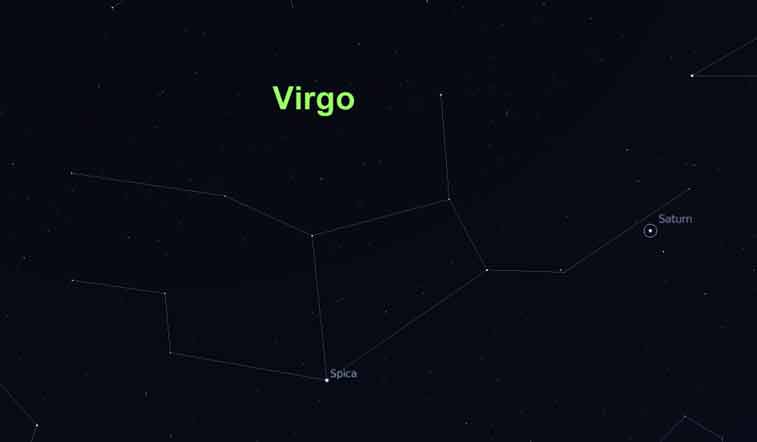
Virgo is a very large Zodiacal constellation. Although it has few bright stars, its brightest, Spica, is the 16th. brightest in the Spring night sky. There are few Milky Way stars here but many galactic stars. Virgo is important as the "Realm of the Nebula", a term coined by Edwin Hubble in the 1920's, to describe an area of its sky that contains a great many bright and distant galaxies. Today we refer to these galaxies as members of the Coma-Virgo Cluster.
--See
you next month!
The star chart above was generated by Stellarium, a free open source planetarium program. The above image was created by Dawn Jenkins, using Stellarium and a graphic editing program to format the image for this web page. Editing was done for educational purposes only. Stellarium offers much more to amatuer astronomers and is being used in planetariums and to guide telescopes in the field. Simple charts like the one above can be used on the internet for non-profit, illustration purposes. Proper credit is due of course! Thank you to the makers of this fine program from Astra's Star Gate.
|
This installment of "Whats Up?" is ©2010 Ronald A. Leeseberg, encoded by Dawn Jenkins for Astra's Stargate.
What's Up Home | The Observer's Page
Links to other Stargate Pages:
[ Astronomy ] [ Space ] [ StarWimin ] [ Starfleet ] [ MayaAstro ] [ Observers ]