
WHAT'S UP?
by Ronald A. Leeseberg, the Star Geezer
Bonus for December 2007
Features: Calendar | Lunar
Almanac | Monthly Topic
When we think about astronomy, we usually associate it
with telescopes. However there is another branch of amateur astronomy that
requires an optical instrument that almost everyone already has. As a matter
of fact, there are many who use these instruments exclusively and don't even
own a telescope. And most folks that use telescopes also use these on occasion.
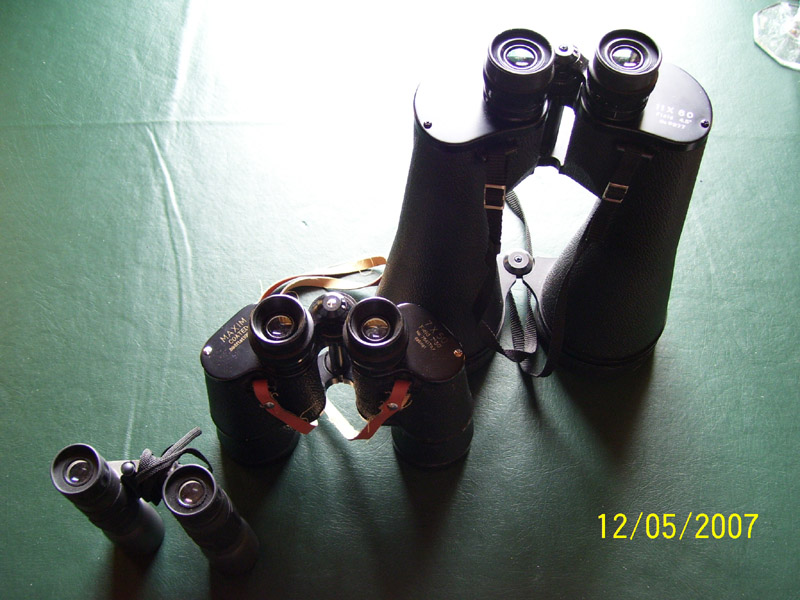
I'm
describing a pair of binoculars (which are really twin, low power telescopes.) By
now you've probably guessed that next year's theme will be BINOCULAR ASTRONOMY.
Almost any binoculars will do for starters. Of course one can purchase
expensive binoculars (not recommended until you really feel the need!) and a
very good pair would still be less expensive that a decent starter telescope.
(Should you, after you are sure that binocular astronomy is really for you, decide
to upgrade, please email me for my recommendations.)
What are some of the advantages? They
are generally light weight and easy to carry. Their image is right side
up so that the transition from naked eye to the binocular image is fairly easy. They
produce a three dimensional image and many astronomical objects are best viewed
at low power and wide field. Of course, binoculars are also useful for
viewing objects here on Earth.
Now to the nitty-gritty of binocular astronomy:
Somewhere on your binoculars you will find a series of numbers. For example,
a typical pair might have the number 7 x 50 printed near the eye pieces. This
number is read: "seven by fifty" and means, the binoculars magnify the naked
eye image seven times and its objective (front) lenses are 50 millimeters in
diameter. The diameter of the objectives is related to the instruments
ability to gather light and the brightness of the image.
A second set of numbers
might read as follows: 367 ft. at 1,000 yds. This means that objects
a thousand yards away would fit into a field 367 feet in diameter. Of course
this measurement is not very useful for astronomers and must be converted into
something more useful. Astronomers usually measure distances in degrees. For
example, the distance from the horizon (0 degrees) to the ZENITH (the point directly
overhead) is 90 degrees. The Moon is about 0.5 degrees across while the
width of your clenched fist when your arm is fully extended is around 10 degrees.
Fortunately it is fairly easy to convert feet/thousand yards to degrees. Just
take the first number (367) and divide it by 52.4. So 367/52.4 = 7.0038
or 7 degrees. (If your binoculars uses metric units, such as 112 meters
at 1,000 meters, divide 112 by 16.)
Two other factors play an important role
in your selection of binoculars if you happen to have more than one pair. How
sharp is the focus to the edge of the visual field? When observing a patch
of sky densely packed with stars, when does the focus become "fuzzy" as you look
from the center to the edge of the field? If you are fortunate to have
binoculars that have a flat focus from center to edge, that's the pair you want
to use, all other characteristics being equal. Secondly, are your binoculars
in optical alignment? Look through one eyepiece and center its view on
some distant object. Without moving the binoculars (perhaps setting them
on a comfortable ladder rung), look through the other eyepiece.; Both fields
should look the same. If not, your eyes will strain to the point of a nasty
headache if you observe very long.
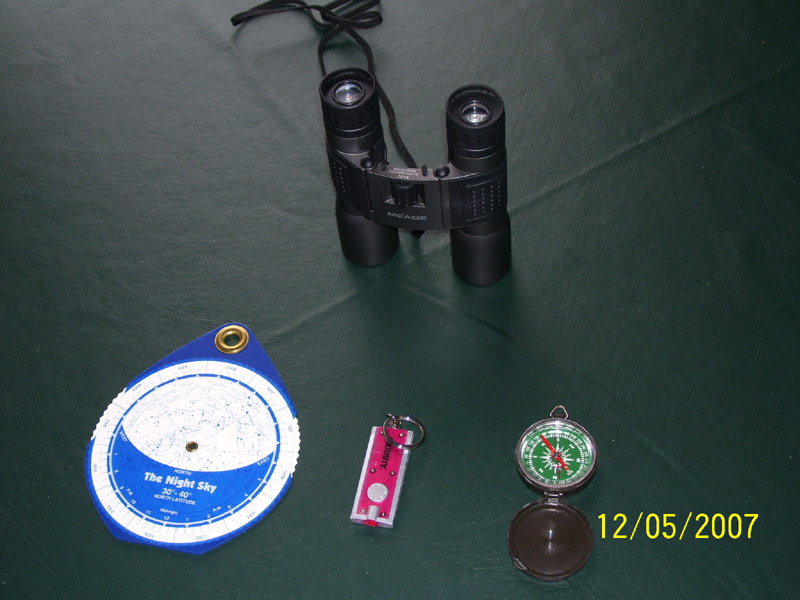
There
a few accessories that I highly recommend in addition to your binoculars. A
small LED flashlight is very useful. I use an inexpensive unit that I've
painted several layers of red nail polish onto its LED. This reduces the
brightness as well as shifting the light from white to red, reducing the damage
to my night vision. I have a pretty poor sense of direction, especially if I
can't see the "big dipper". Therefore, I always carry a small pocket compass.
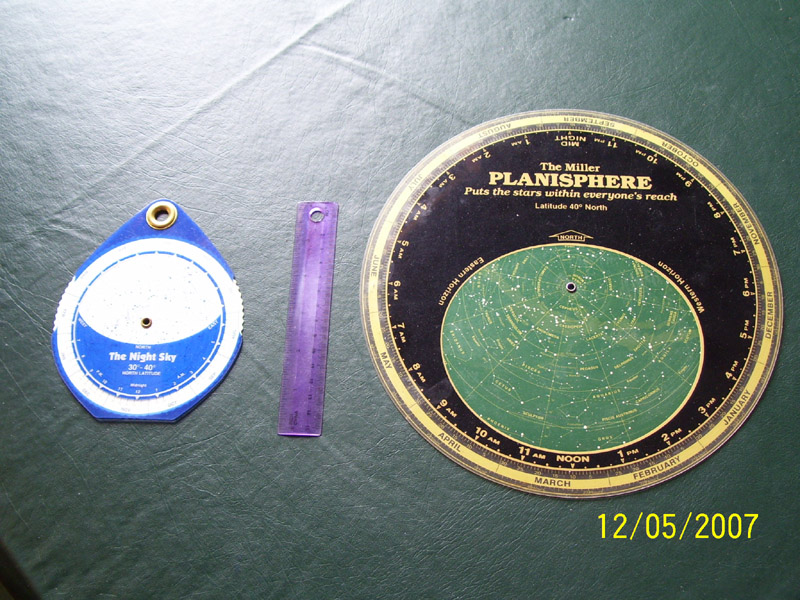
The most important accessary is my Planisphere.; This is a circular device that
allows me to set the day and time to display the bright objects that are visible
then in the night sky. These are available in many styles and sizes through
the Internet, many bookstoresas well as at natural history
museums.
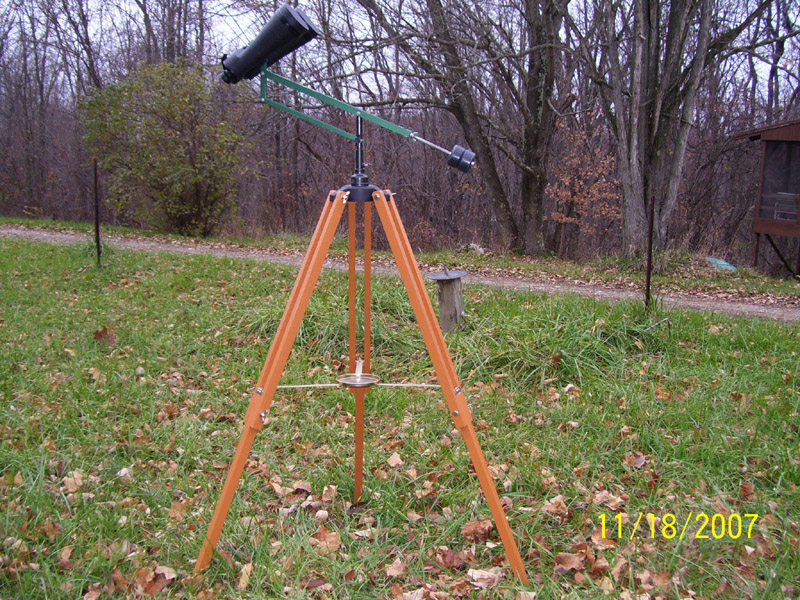
Finally, Astronomer Roy Bishop
has developed a very simple way to compare the performance of binoculars. Just
multiply the binocular's magnification by its lens diameter. Examples: My "big" binoculars,
that requires a tripod to use (so much for portability!), are 11 x 80 = 880. My
7 x 50's = 350 and my pocket unit (useful only for the Moon and bright planets)
is 8 x 22 = 176. Many feel that 10 x 50's are the ideal astronomical binoculars
so a Bishop number of 500 would be most desirable.
Have a great holiday season
and a happy New Year!!
Ron, the star geezer.
This installment of "Whats Up?" is ©2007 Ronald A. Leeseberg,
encoded by Dawn Jenkins for Astra's Stargate.
Top of Page

What's Up Home | The Observer's Page
Links to other Stargate Pages:
[ Astronomy ] [ Space ] [ StarWimin ]
[ Starfleet ] [ MayaAstro ]
[ Observers ]
 Beam
me back, Astra
Beam
me back, Astra

